Online Bachelor’s Degrees for Working Professionals in Qatar: Your Guide to Career Advancement
Online Bachelor’s Degrees for Working Professionals in Qatar: Your Guide to Career Advancement
The professional landscape in Qatar and across the GCC is evolving rapidly. Whether you’re working in Doha’s bustling business district, managing projects in Saudi Arabia, or leading teams in the UAE, you’ve probably felt it—that nagging thought that you need more credentials to climb the next rung of your career ladder.
I’ve spoken with countless professionals in the region who share the same story. They’re talented, experienced, and proven in their roles. Yet when promotion opportunities arise, they’re often overlooked in favor of candidates with formal qualifications. It’s frustrating, especially when you know you’re capable of so much more.
This is where online education becomes not just an option, but a strategic career move for ambitious working professionals in the GCC.
Why Online Education Is Perfect for Qatar GCC Working Professionals
Let’s be honest—traditional on-campus programs simply don’t work for most working professionals in Qatar and the broader Gulf region. Between demanding work schedules, family commitments, and the often unpredictable nature of project deadlines, finding time to attend physical classes is nearly impossible.
Online Bachelor’s Degrees in Qatar offer a practical solution. You can study at your own pace, access lectures when it suits your schedule, and complete assignments without sacrificing your current income or career momentum. For professionals balancing multiple responsibilities, this flexibility isn’t just convenient—it’s essential.
Many multinational companies operating in Qatar, Saudi Arabia, the UAE, Kuwait, Bahrain, and Oman now actively encourage their employees to pursue online qualifications from recognized universities. They understand that investing in employee education creates better leaders and more competent teams.
Why a Bachelor’s Degree Still Matters So Much in Qatar’s Job Market
Let’s be direct about something that a lot of career advice dances around: in Qatar’s competitive job market, an online bachelor’s degree is not just a nice-to-have. For a wide range of leadership, supervisory, and management roles, it is a hard requirement.
This is true across industries. Whether you work in banking and finance, oil and gas, healthcare, logistics, construction, hospitality, or the public sector, the moment you start targeting roles above a certain pay grade or seniority level, you will encounter the bachelor’s degree requirement. It shows up in job postings, visa upgrade criteria, performance appraisal frameworks, and internal promotion policies.
Qatar’s Vision 2030 is also reshaping the professional landscape. The country’s human capital development agenda emphasises formal qualifications as a baseline for leadership, particularly in government-adjacent and national development roles. For Qatari nationals aiming for leadership positions, and for expat professionals seeking long-term career stability in the country, academic credentials are becoming more important — not less.
For the thousands of working professionals in Qatar who are highly experienced but degree-less, this creates a specific kind of frustration: the feeling that years of real-world contribution are being discounted because of a piece of paper.
An online bachelor’s degree is how you close that gap — on your own terms, without disrupting the career and income you’ve already built.
Understanding Your Education Options in Qatar
When you start researching online education options in the GCC, you’ll quickly discover there are several pathways available. Let’s break down what each level offers and who they’re designed for.
Online Diploma Programs
Diploma programs serve as an excellent starting point for professionals who want to formalize their skills without committing to a full degree immediately. These programs typically take 1-3 years to complete and provide specialized knowledge in specific fields.
In Qatar’s job market, diplomas in accounting and finance, logistics and supply chain management, human resource management, and business management are particularly valued. If you’re working in operations, administration, or mid-level management, a diploma can provide you with a theoretical framework to support your practical experience.
What makes diplomas especially attractive is their affordability and shorter duration. You can complete your qualification while continuing to work full-time, and the knowledge you gain can be immediately applied to your current role.
Online Undergraduate Programs (Bachelor’s Degrees)
For many working professionals in the GCC, not having a bachelor’s degree is the single biggest barrier to career advancement. It doesn’t matter how many years of experience you have—without that undergraduate qualification, certain doors simply won’t open.
Online bachelor’s programs in business administration, commerce, computer applications, and specialized fields like journalism or education finally let you check that box. Most programs designed for working professionals offer accelerated pathways and give credit for relevant work experience, reducing the overall time to completion.
In my conversations with GCC professionals who’ve completed online bachelor’s degrees, the most common feedback is relief. They finally feel they’re being considered for the promotions and opportunities they’ve deserved all along.
Online Postgraduate Programs (Master’s Degrees)
If you already have a bachelor’s degree and you’re aiming for senior management or leadership positions, a master’s degree becomes crucial. In competitive markets like Qatar, Dubai, and Riyadh, an MBA or specialized master’s degree can be the differentiator between you and other qualified candidates.
Online MBA programs are especially popular among GCC working professionals because they focus on practical, real-world business challenges. You’re not just learning theory—you’re acquiring frameworks and strategies you can implement immediately in your workplace.
Master’s programs in project management, healthcare management, finance, supply chain management, and human resources are designed for working professionals. The coursework often involves case studies from regional companies, making the learning directly relevant to the GCC business environment.
Online Doctorate Programs (PhD and DBA)
For professionals aspiring to executive-level positions, consulting roles, or academic careers, doctorate programs represent the pinnacle of academic achievement. A PhD or Doctorate in Business Administration (DBA) signals to employers that you possess advanced research capabilities, strategic thinking skills, and deep expertise in your field.
In Qatar and the broader GCC, holding a doctoral qualification opens doors to advisory boards, government consultation opportunities, and senior leadership positions that require this level of credential. While it’s a significant commitment, the career benefits can be transformative.
The Unique Advantages of UK and European Online Degrees
When exploring online education options in Qatar, you’ll notice that UK and European universities offer many reputable programs. There’s a good reason for this preference among GCC employers.
UK degrees, in particular, carry significant weight in the regional job market. The British education system is widely recognized for its rigorous academic standards, and qualifications from accredited UK universities are highly respected by multinational corporations and government entities throughout the Gulf.
Programs from universities like the University of Essex, Plymouth Marjon University, and the University of Liverpool offer the same degree you would receive if you studied on campus in the UK. The qualification doesn’t distinguish between online and on-campus study—it’s the same certificate, the same academic standards, and the same recognition.
European institutions from Switzerland and other countries also bring specialized programs that combine practical business knowledge with academic rigor. For professionals in Qatar looking to differentiate themselves, these international qualifications demonstrate a global perspective that’s increasingly valued in the GCC’s diverse business environment.
How Online Learning Actually Works for Busy Professionals
If you’ve never experienced online education, you might wonder how it actually works day to day. Let me walk you through a typical week for a working professional pursuing an online degree in Qatar.
Most programs use a Learning Management System (LMS)—an online platform where all your course materials, lectures, assignments, and resources live. You log in at whatever time works for you—early morning before work, during lunch breaks, late evening after the kids are asleep, or on weekends.
Lectures are typically pre-recorded, meaning you can watch them at your convenience. Some programs also offer live sessions, but these are usually recorded as well, so you’re never penalized for missing a real-time class due to work commitments.
Assignments have deadlines, but they’re structured to give you several weeks to complete them. This allows you to plan around your work schedule. During busy periods at work, you might study less; during quieter weeks, you can push ahead.
The beauty of this model is that it respects the reality of professional life. Your employer doesn’t need to give you time off. You don’t need to relocate or commute. You simply integrate study into your existing routine in whatever way works best for you.
Career Advancement Opportunities with Online Degrees in the GCC
Let’s talk about what really matters—how these qualifications translate into career growth in Qatar and the wider Gulf region.
Breaking Through the Promotion Ceiling
Many professionals reach a point where their experience alone isn’t enough. Companies have formal requirements for senior positions, and without the right educational credentials, you’re simply not considered—regardless of your capabilities.
An online degree breaks through this ceiling. Suddenly, you’re eligible for roles that were previously off-limits. Managers with online MBAs find themselves considered for director positions. Specialists with bachelor’s degrees become eligible for team leader roles.
Switching Careers or Industries
The GCC job market is dynamic, and many professionals want to pivot from one sector to another. Maybe you’ve been in operations but want to move into strategy. Perhaps you’re in a technical role but aspire to a general management role.
Online degree programs provide the foundational knowledge you need to make these transitions credible. A marketing professional completing an MBA in finance can realistically pursue financial management roles. An engineer with a master’s in project management can transition into project leadership across various industries.
Increasing Your Market Value
In Qatar’s competitive salary environment, formal qualifications directly impact earning potential. HR departments use salary bands, which are often tied to educational qualifications. An MBA can justify a 20-30% salary increase when moving to a new role or negotiating compensation.
Beyond the immediate financial impact, the network you build during your studies—fellow students, professors, alums—becomes valuable for future opportunities throughout your career in the region.
Meeting Government and Corporate Requirements
Certain sectors in Qatar and the GCC have specific educational requirements for leadership positions. Government entities, in particular, often mandate master’s or doctoral qualifications for director-level and above positions.
Similarly, many multinational corporations operating in the region have global standards requiring specific educational credentials for senior roles. Having the right degree ensures you’re eligible when these opportunities arise within your organization.
Real Professionals, Real Results
Salford Education has been doing this since 2011. More than 5,500 students have enrolled in programmes through the consultancy, and over 3,500 have graduated — many of them working professionals in Qatar who started exactly where you are now.
Student feedback aligns with the numbers. Professionals who completed their BBA through Salford report gaining the confidence to apply for roles they previously felt locked out of. Some secured promotions within their existing organisations. Others used their new qualification to make the career switch they had been planning for years. One student described the experience simply: “Salford didn’t just give me a degree — they gave me the tools to move up.”
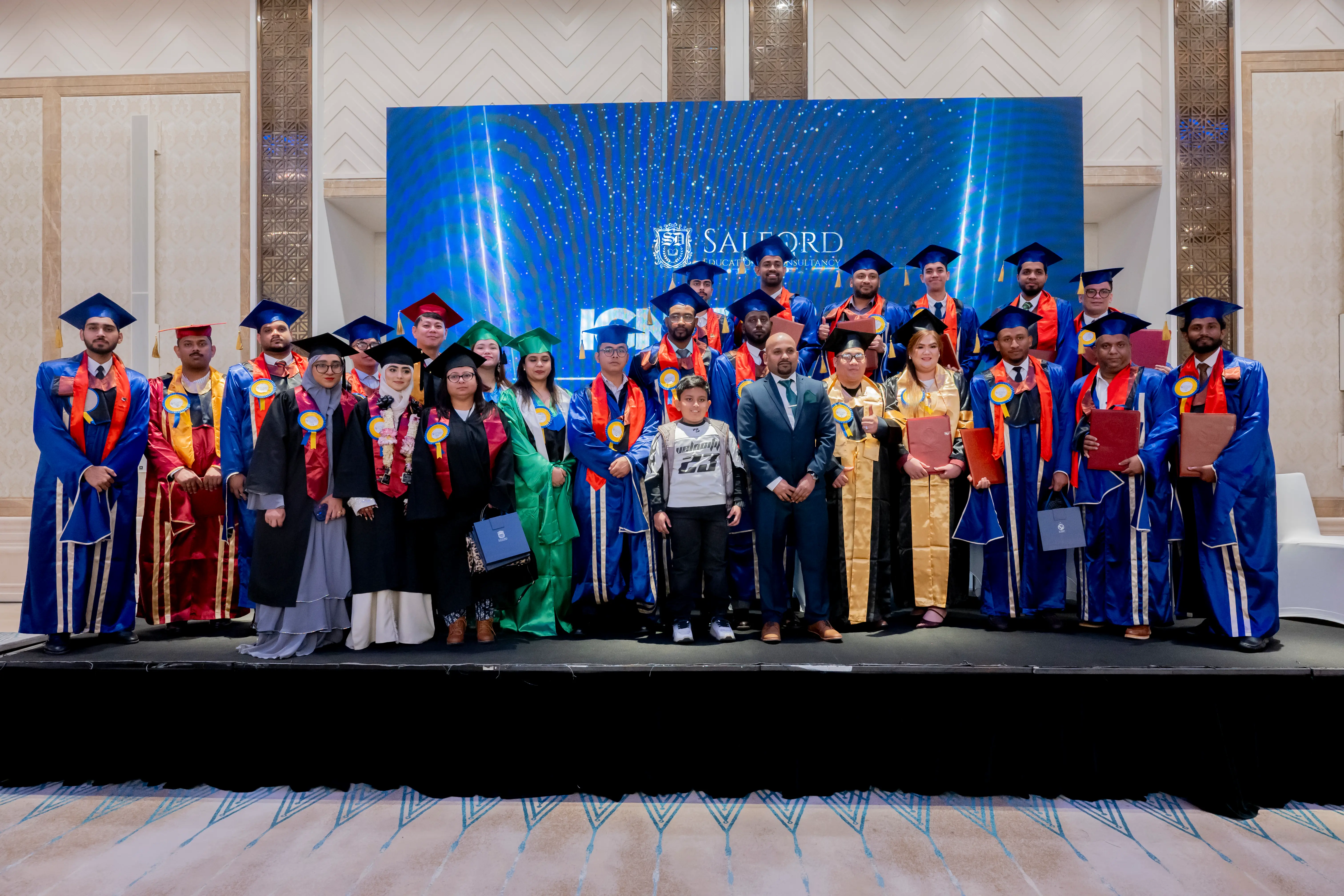
In January 2026, Salford hosted the Ignatia ’26 Convocation Ceremony in Qatar — the largest graduation event of its kind in the region. Bachelor’s graduates walked across the stage in Doha to collect their degrees in a formal ceremony, surrounded by their families and peers. Online education, real graduation — the two are not mutually exclusive.
Salford students have also had access to experiences such as the Oxford Leadership and Strategy Masterclass at Lady Margaret Hall, University of Oxford, which gives working professionals direct exposure to world-class faculty and executive leadership thinking. This kind of value-add is unusual in the consultancy space and reflects Salford’s commitment to genuine career development rather than just qualification delivery.
Choosing the Right Program for Your Career Goals
Not all online programs are created equal, and choosing the right one requires careful consideration of your specific situation and aspirations.
Align with Your Industry
If you’re in healthcare management, an MBA specializing in healthcare makes more sense than a general business degree. Working in logistics? A supply chain management specialization will be more immediately applicable than a finance specialization.
The key is finding programs that address the challenges and opportunities in your specific field within the GCC context.
Consider Accreditation and Recognition
This cannot be emphasized enough—ensure any program you pursue is offered by a properly accredited university. In Qatar and throughout the GCC, employers verify educational credentials, and degrees from unaccredited institutions can actually harm your career rather than help it.
Look for universities with proper accreditation from recognized bodies in their home countries. UK universities should have approval from the Quality Assurance Agency (QAA). Check that the degree will be recognized by the Qatar Ministry of Education or equivalent bodies in your country.
Evaluate Time Commitment Realistically
Be honest about how much time you can dedicate to studying while maintaining your work performance and personal life. A program that looks perfect on paper won’t help you if you can’t realistically complete it.
Most working professionals in the GCC find that dedicating 10-15 hours per week to study is manageable. Some programs are designed to be completed in as little as 12 months; others may take 2-3 years. Choose based on your capacity, not just your ambition.
Assess Support Services
Quality online programs designed for working professionals provide robust support. This includes academic advisors who understand the challenges of balancing work and study, technical support for the online platform, library access for research, and peer networks for collaboration and mutual support.
Before enrolling, ask about these services. They can make the difference between completing your degree and struggling to keep up.
The Financial Investment and Returns
Let’s address the practical question—what does this cost, and is it worth it?
Online degree programs typically cost less than their on-campus equivalents, but they still represent a significant investment. In the Qatar market, you might pay anywhere from QAR 15,000 to QAR 80,000 or more, depending on the program level and institution.
Many programs offer installment payment plans that spread the cost over the duration of your studies. This makes the financial burden more manageable, as you’re paying while continuing to earn your salary.
When calculating return on investment, consider not just immediate salary increases but long-term career trajectory. A professional who invests in an MBA at age 32 and works another 25-30 years will likely see returns many times over the initial investment through promotions, increased earning capacity, and expanded opportunities.
Some employers in Qatar and the GCC offer educational assistance or reimbursement programs. If you’ve been with your company for several years and are viewed as a high performer, it’s worth inquiring about such support before enrolling.
Balancing Work, Family, and Study in the GCC Context
One of the biggest concerns for working professionals considering online education is whether they can realistically manage everything. Living and working in Qatar or elsewhere in the GCC comes with its own unique pressures and cultural considerations.
The key is setting realistic expectations with everyone involved—your employer, your family, and yourself.
Managing Work Expectations
Be transparent with your manager about your educational pursuits. Most employers in the region view employee development positively, especially when it aligns with organizational needs. You might find unexpected support, whether it’s flexibility during exam periods or understanding when you need to submit major assignments.
However, your work performance should not suffer. The programs designed for working professionals assume you’ll continue to perform at your job. This means being disciplined about time management and perhaps making short-term sacrifices in other areas.
Family Considerations
For professionals with families, study time must be carved out without neglecting important relationships. This might mean studying after children are asleep, using your commute time for reading, or designating weekend mornings for focused study.
The temporary nature of this commitment helps. Your family understands that this is a 1-3 year investment in your shared future, not a permanent change to your availability.
Cultural and Religious Observations
Online programs accommodate the GCC lifestyle, including prayer times, Ramadan, and cultural holidays. The flexibility of recorded lectures means you can adjust your study schedule around these important observances without falling behind.
Success Stories from the Region
The most powerful validation comes from professionals who’ve already walked this path.
I’ve met project managers in Doha who completed online MBAs while managing multi-million riyal construction projects. They studied in the evenings and on weekends, and within a year of completing their studies, moved into senior management positions they’d been pursuing for years.
There’s the HR specialist in Dubai who earned her master’s in human resource management entirely online while working full-time. The qualification made her eligible for an HR director role in Qatar, representing both a significant salary increase and the professional recognition she’d been seeking.
Consider the engineer in Saudi Arabia who pursued an online DBA while continuing to work. Three years later, he’s now consulting for major energy companies across the region, commanding fees that would have been impossible without the doctoral credential.
These aren’t exceptional cases—they’re representative of what happens when motivated professionals invest in their education while maintaining their career momentum.
Taking the First Step
If you’ve read this far, you’re probably seriously considering pursuing an online degree. Here’s how to move forward practically.
Research Your Options
Start by identifying 2-3 programs that align with your career goals and industry. Look at the curriculum, read about the faculty, and understand the support structure. Most reputable institutions offer information sessions or consultation calls where you can ask specific questions.
Assess Your Readiness
Be honest about your current situation. Do you have 10-15 hours per week to dedicate to study? Can you afford the tuition, or do you need to explore financing options? Is this the right time in your career and personal life to take on this commitment?
Verify Credentials
Before enrolling, verify that the degree will be recognized in Qatar or your specific GCC country. Check with the Ministry of Education or equivalent authority if needed. This step prevents potentially investing time and money in a qualification that won’t serve your career goals.
Plan Your Finances
Understand the total cost, payment schedule, and any additional expenses, such as textbooks or exam fees. If seeking employer support, prepare a proposal explaining how the program benefits both you and the organization.
Set Yourself Up for Success
Once enrolled, create a dedicated study space at home, set a consistent study schedule, connect with fellow students for peer support, and communicate your commitment to family and colleagues.
The Changing Landscape of Professional Education in Qatar
The way we think about education and career development is shifting throughout the GCC. Gone are the days when you completed your education in your early twenties and that was it for life. Today’s professionals recognize that learning is continuous, and formal education at various career stages is increasingly normal.
Qatar’s Vision 2030 and similar development plans across the Gulf emphasize a knowledge economy and human capital development. There’s growing recognition at both government and corporate levels that investing in workforce education strengthens the entire economy.
For individual professionals, this creates a favorable environment. Employers are more supportive of employee education. Recognition of online degrees has improved significantly. The stigma that once existed around distance learning has largely disappeared, especially as prestigious universities have embraced online program delivery.
Is This Right for You?
Only you can answer this question, but consider these points as you decide.
If you’re feeling stuck in your current role despite strong performance and experience, formal education might be the missing piece. If you’re being passed over for promotions because you lack specific credentials, an online degree addresses that directly. If you’re planning a career transition and need credibility in a new field, structured education provides that foundation.
On the other hand, if you’re content with your current career trajectory and don’t feel credentials are limiting you, the investment might not make sense right now. If your industry doesn’t value formal qualifications, your time might be better spent elsewhere. If you’re in a period of significant personal or professional upheaval, waiting for more stable circumstances could be wise.
Looking Forward
The professional landscape in Qatar and across the GCC will continue to evolve. Competition for senior positions will likely intensify. Requirements for formal qualifications, particularly at leadership levels, will probably increase rather than decrease.
For working professionals who want to stay competitive and open to opportunities, investing in education isn’t just about getting a degree—it’s about positioning yourself for a dynamic future in one of the world’s most rapidly developing regions.
The professionals who thrive in tomorrow’s GCC job market will be those who recognize today that education is not a destination but a journey, and that formal qualifications are increasingly essential tools for career advancement in the modern Gulf economy.
Your career is ultimately your responsibility. The company you work for today might not exist in ten years. The industry you’re in might transform beyond recognition. But your education—that stays with you. It’s portable, valuable, and opens doors regardless of economic shifts or organizational changes.
If you’ve been considering an online degree for months or even years, perhaps it’s time to stop considering and start planning. The best time to begin was yesterday. The second-best time is today.
Frequently Asked Questions
Are online degrees from UK universities recognized in Qatar?
Yes, online degrees from properly accredited UK universities are widely recognized in Qatar and throughout the GCC. The key is ensuring the university has proper accreditation and that the degree doesn’t distinguish between online and on-campus study.
How long does it take to complete an online degree while working full-time?
It varies by program level and your individual pace. Diplomas typically take 1-3 years, bachelor’s degrees 3-4 years, master’s degrees 12-24 months, and doctorate programs 2-4 years. Many programs designed for working professionals offer accelerated pathways.
Can I get a promotion based on an online degree?
Many professionals in Qatar and the GCC have received promotions after completing online degrees. However, the degree alone doesn’t guarantee promotion—it makes you eligible and competitive for positions that require specific educational credentials.
Will my employer in Qatar support my online education?
Many employers in the region offer educational assistance or reimbursement programs, particularly for long-term employees pursuing relevant qualifications. It’s worth discussing with your HR department or manager.
What’s the difference between a DBA and a PhD?
A DBA (Doctorate in Business Administration) is practice-oriented and focused on applying research to real business problems. A PhD is more research-focused and academic. For working professionals aiming for executive roles, a DBA is often more relevant.
How much does an online degree cost in Qatar?
Costs vary significantly by program and institution, typically ranging from QAR 15,000 to QAR 80,000 or more. Many institutions offer installment payment plans to make the investment more manageable.
Do I need to take time off work to study?
No. Programs designed for working professionals are structured so you can study in the evenings, weekends, and during your free time. You should not need to take leave from work except possibly for final exams, if required.
Will the time zone difference affect my studies?
Most programs designed for international students use recorded lectures and asynchronous learning, so time zone differences aren’t a barrier. Any live sessions are typically recorded for later viewing.