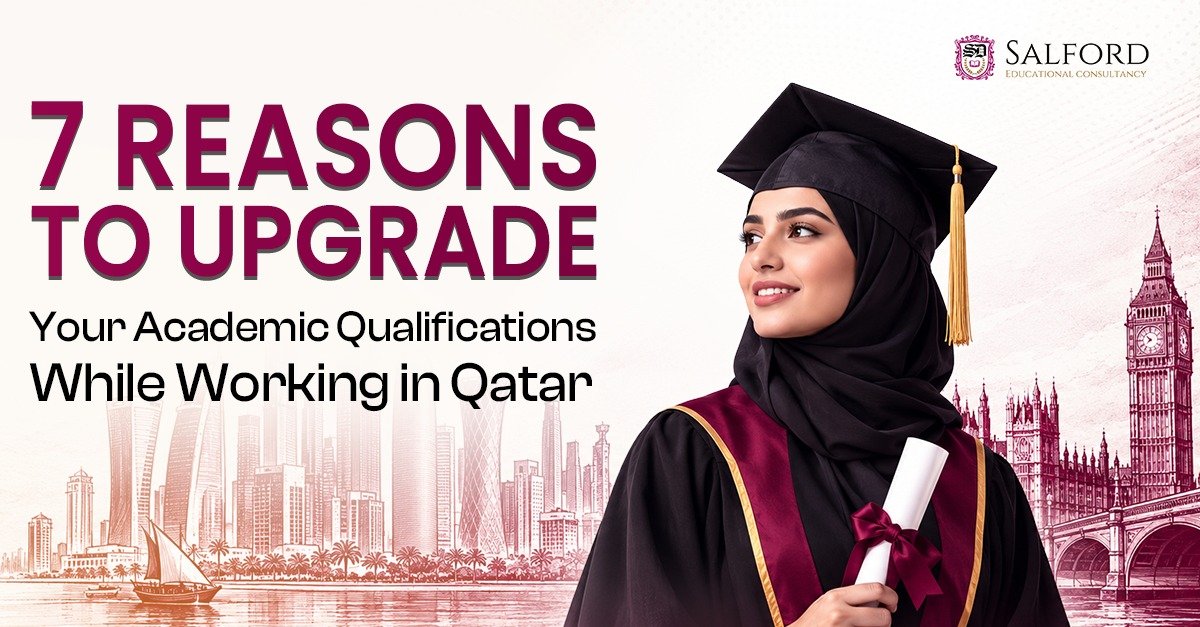
You’ve gained experience, taken on more responsibility and learned a lot on the job. But when the next promotion or a new opportunity comes up, is your current qualification enough?
If you are a working professional in Qatar, this is a question worth considering. Career goals change. You may want to move into management, or looking for a better role or planning a switch to a different industry. In these scenarios, an academic qualification becomes an important part of that step.
Upgrading your academic qualifications in Qatar can help you build relevant knowledge, meet the educational requirements for certain positions and strengthen your professional profile. It isn’t a guarantee of promotion or a new job, but it can give you more options to work towards.
And you don’t necessarily have to put your career on hold to study. Here are seven reasons to consider going back to education while continuing to work.
1. Can a higher qualification help you prepare for a promotion?
It can, particularly when the role you’re working towards requires a higher level of academic education or knowledge.
Imagine you’ve spent several years in an operational role. You understand the work, know how your team functions and have started handling responsibilities beyond your job description. Now, a supervisory or management position becomes available.
Your experience matters. But the employer may also look for formal knowledge in areas such as business management, finance, strategic planning or leadership.
This is where a relevant bachelor’s or master’s degree may support your career plans. It can help you develop the academic understanding needed to take on more complex responsibilities, alongside the practical knowledge you’ve gained at work.
A qualification won’t automatically put you on a promotion list. Still, if your next career step calls for stronger academic credentials, it’s worth checking whether your current qualification meets the requirement.
2. Will upgrading your qualifications improve your job opportunities in Qatar?
A relevant qualification may help you meet the academic criteria for more positions and make your CV more competitive.
When you review job vacancies, look beyond the job title. The responsibilities, required experience and academic criteria can tell you what an employer expects from a candidate.
For example, a professional with a bachelor’s degree in an unrelated field may find that certain business or management positions ask for a qualification in a specific discipline. Someone with a diploma may come across roles where a bachelor’s degree is listed as a minimum requirement.
These are situations where further education may be worth considering.
With Qatar’s Third National Development Strategy (NDS3) identifying a future-ready workforce as one of its seven national outcomes and its 2030 ambition being having skilled and high-skilled jobs account for more than 46% of the total workforce, it can be understood that upskilling has become important.Eventhough, this is a future target, not a measure of the workforce today.
So, the practical takeaway is simple: understand the direction you want your career to take, then identify the qualifications relevant to the roles you’re targeting.
Before enrolling, compare job descriptions from several employers in your sector. Look for recurring academic requirements rather than choosing a degree based on its title alone.
3. Can a new qualification help you change careers or industries?
Yes, a carefully chosen qualification can help you build the academic foundation for a career transition.
People change career direction for different reasons. You might have discovered an interest in another field, reached a point where your current role offers limited progression, or realised that your existing qualification doesn’t match the work you want to do next.
A qualification in a new discipline may help bridge that gap.
For instance:
- A professional with a technical background may consider business or management studies when preparing for a move into operations.
- Someone working in administration may consider human resource management to build knowledge relevant to HR roles.
- A professional interested in business analysis may look into programmes that develop their understanding of business operations, data and decision-making.
- Someone moving towards a leadership role may consider postgraduate business education.
Your existing experience doesn’t become irrelevant when you change industries. Skills such as communication, problem-solving, project coordination and team management can transfer across different roles.
The important part is choosing a programme that connects your previous experience with your intended career direction. A degree should support a clear next step, not simply add another qualification to your CV.
[Internal Link: Suggest Anchor Text – Bachelor’s Degree Programmes]4. How does a higher qualification strengthen your CV?
It gives employers another way to assess your academic background, especially when a role has specific qualification requirements.
Your CV tells a story about your professional development. It includes where you’ve worked, what you’ve handled, the skills you’ve developed and the qualifications you’ve earned.
A relevant academic qualification can strengthen that picture. It may show that you’ve developed knowledge beyond your original area of study or taken steps to prepare for greater responsibilities.
Consider two candidates with similar work experience applying for a role that requires a background in business management. If one candidate also holds a relevant management qualification, that academic background may help demonstrate that they meet the stated education criteria.
But a degree isn’t a substitute for relevant experience. Employers may also consider your previous roles, technical abilities, communication skills and suitability for the position.
Think of your qualification and experience as complementary parts of your professional profile. One demonstrates what you’ve studied; the other shows how you’ve applied your knowledge at work.
If your current CV doesn’t reflect the level of responsibility you’re ready to take on, reviewing your academic qualifications could be a useful starting point.
5. Can an MBA or master’s degree help you move into management?
It can help you develop business and leadership knowledge relevant to management responsibilities.
Moving into management involves more than being good at your current job. You’ll need to understand how teams operate, how decisions affect business performance and how different departments contribute to organisational goals.
An MBA or a relevant master’s degree may help you build knowledge in areas such as:
- Strategic management and business planning
- Financial management and budgeting
- Organisational behaviour
- Leadership and team development
- Business operations and decision-making
- Project and performance management
These subjects can be useful if you’re moving from a specialist or technical position into a role with broader responsibilities.
For example, an experienced engineer who wants to move into operations management may benefit from developing a stronger understanding of business strategy, budgeting and organisational management. A professional already supervising a team may want to strengthen their knowledge of leadership and decision-making.
An MBA isn’t a requirement for every management position. Some employers place greater weight on industry experience, technical expertise or previous leadership responsibilities. Check the requirements of the roles you’re interested in before deciding which qualification makes sense.
6. Why should working professionals keep learning as industries change?
Because the knowledge and skills needed in your field may not stay the same throughout your career.
Technology, business processes, regulations and customer expectations can change how organisations operate. A professional who qualified several years ago may now be working with systems, responsibilities or business practices that weren’t part of their original education.
The World Economic Forum’s Future of Jobs Report 2025 estimates that 39% of workers’ existing core skills could change or become outdated by 2030. This is particularly relevant in the global context.
Continuous learning can help professionals review what they know, identify gaps and prepare for changing responsibilities.
In Qatar, research by Invest Qatar and Deloitte has also highlighted the growing importance of digital competencies as businesses adopt new technologies. The report, Qatar’s Digital Frontier: Mapping the Future of Skills, discusses the need to align workforce capabilities with changing industry requirements.
A degree isn’t the only way to develop new skills. Short courses, professional certifications and workplace training can all have a role. But when your career goals require a recognised academic qualification or deeper subject knowledge, a bachelor’s, master’s or MBA programme may be worth considering.
The best choice depends on your profession, the skills you need and the type of role you’re preparing for.
[Outbound Link: World Economic Forum – Future of Jobs Report 2025][Outbound Link: Invest Qatar and Deloitte – Qatar’s Digital Frontier]7. Can you upgrade your qualifications in Qatar without leaving your job?
Yes. Online and distance-learning programmes can give working professionals another route to higher education while they remain employed.
Leaving a job to study full-time isn’t practical for everyone. Work schedules, financial commitments and professional responsibilities can make traditional campus-based study difficult.
Online degree programmes offer a different arrangement. Depending on the university and programme, you may be able to access learning materials remotely, complete assignments online and organise study time around your work schedule.
This can make it easier to pursue a bachelor’s degree, master’s qualification or MBA without relocating or stepping away from your current role.
However, flexibility doesn’t mean you can study without a plan. Before enrolling, check:
- Study format: Are lectures live, recorded or self-paced?
- Time commitment: How many hours of study will you need each week?
- Assessment method: Are assignments, examinations or other assessments completed online or in person?
- Programme duration: How long will it take to complete the qualification?
- University status: Is the awarding institution properly recognised or accredited in its relevant jurisdiction?
- Recognition in Qatar: Does the programme meet the requirements of the relevant Qatar authority or professional body for your intended purpose?
The last point deserves particular attention. Qatar’s Ministry of Education and Higher Education has specific regulations for university degree equivalency and validation. Requirements can depend on the institution, qualification and mode of study. Don’t assume that every overseas online degree will automatically receive equivalency in Qatar.
If you need a qualification for a regulated profession, public-sector role or a specific employer, check the relevant requirements before paying fees or enrolling.
Final Thoughts: Make Your Next Qualification Count
Upgrading your academic qualifications is a decision that deserves more thought than simply choosing the next available degree.
Start with your career goal. Are you preparing for a promotion, considering a move into management, changing industries or trying to meet the academic requirements of a particular role?
Once you know what you’re working towards, compare programmes based on their subject, awarding university, study format, duration and recognition requirements.
For working professionals in Qatar, flexible online and distance-learning options may make it possible to continue working while pursuing higher education.
Salford Education supports professionals in Qatar and the GCC who are considering UK and European degree programmes. From programme selection and application guidance to university liaison and enrolment support, its team can help you understand the available study options.
The degree is awarded by the university, which also determines admission decisions and academic requirements.
Thinking about your next qualification? Speak to Salford Education about degree options that fit your career plans and work commitments.