
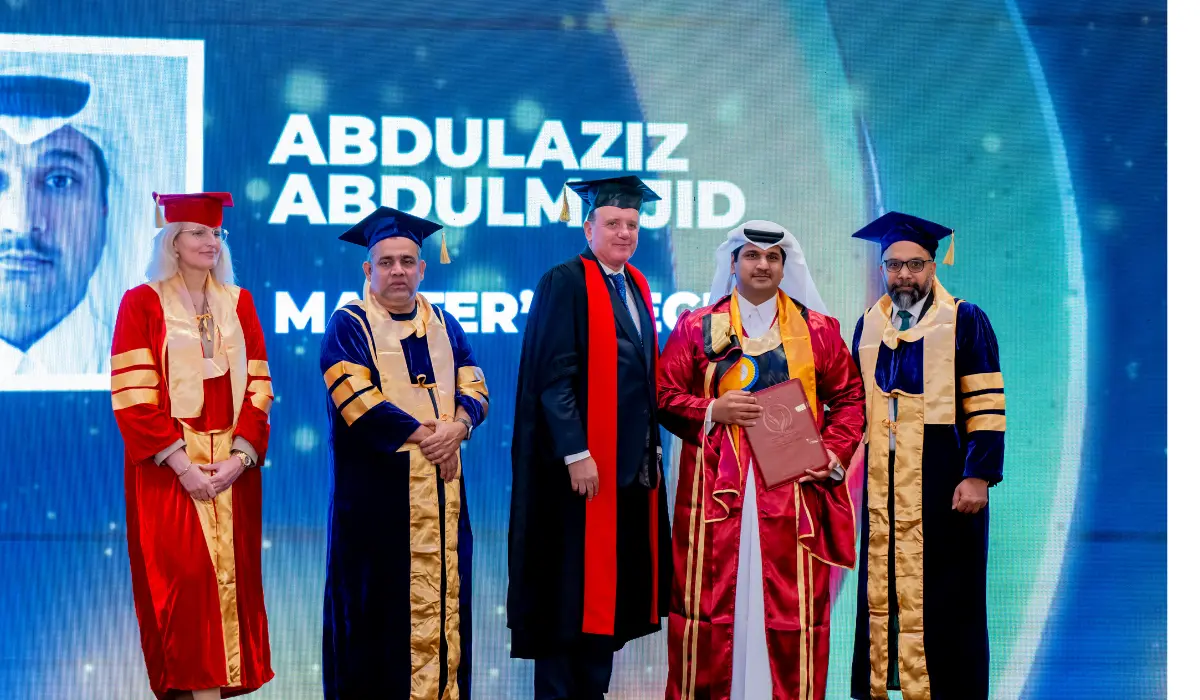
Online MBA in Qatar: A Strategic Leadership Investment for Working Professionals and Executives
Online MBA in Qatar: A Strategic Leadership Investment for Working Professionals and Executives
By user April 27, 2026
The Leadership Gap No One Talks About Openly
There is a quiet pressure building in Qatar’s corporate environment that most senior professionals feel but rarely discuss out loud.
The technical expertise that earned you your current position — whether you are a CEO, CTO, operations director, or department head — is no longer the ceiling. Boards, shareholders, and international stakeholders now expect leadership fluency across finance, strategy, people management, and commercial growth. The expectation has shifted. The credential gap is real.
An online MBA in Qatar is not a qualification for beginners. For working professionals already operating at a high level, it is a strategic move — one that consolidates experience, adds academic rigour, and signals to every room you walk into that your thinking is both tested and current.
This blog walks through why senior professionals across Qatar are making this decision now, what to look for in a programme, how to choose the right education partner, and what the best structure for this kind of career investment actually looks like.
Why Qatar’s Business Environment Is Pushing Executives Toward Postgraduate Education
Qatar’s National Vision 2030 has deliberately accelerated diversification across technology, finance, healthcare, and infrastructure. What this means at the individual level is that the talent market has become simultaneously more opportunity-rich and more competitive.
International firms operating out of Doha benchmark candidates against global qualification standards. Regional organisations are increasingly professionalising their leadership pipelines. High-potential managers who plateau without a formal advanced qualification find themselves passed over — not because of performance, but because the credential conversation happens before the performance conversation ever does.
A UK-accredited MBA changes that dynamic. It provides a credential that is internationally legible, academically rigorous, and — critically — achievable without stepping away from the role you have spent years building.
The online format is not a lesser version of the classroom. For an executive who can apply strategic finance frameworks to a real budget conversation the same week they study them, the learning compounds in a way that purely academic environments rarely achieve.
The Triple Qualification Advantage: More Than a Degree
Not all MBA programmes are structured the same way. Some deliver a single qualification. The programme available through Salford Education Consultancy, in partnership with Plymouth Marjon University, UK, delivers three.
Students graduate with:
MBA Degree from Plymouth Marjon University, United Kingdom. A fully accredited postgraduate degree from a recognised UK institution, aligned with UK higher education quality standards.
Level 11 Diploma from the Scottish Qualifications Authority (SQA). An independently recognised qualification that carries weight across academic and professional contexts in the UK and internationally.
Professional Certification Membership from the Chartered Management Institute (CMI), UK. The CMI is a professional body specifically focused on management and leadership. Membership provides access to ongoing development resources, research, and a professional network that remains active long after graduation.
For a senior executive, the CMI membership is not supplementary. It connects you to a global community of management professionals and gives you access to frameworks and peer conversations that have direct operational relevance.
Completing all three qualifications takes approximately 12 months. The programme is designed to be completed alongside full professional commitments.
What the Curriculum Actually Covers for Senior Professionals
MBA programmes frequently describe themselves as “industry-relevant” and “leadership-focused” without being specific about what that means for someone already operating at the top of an organisation.
The programme covers strategic leadership, advanced financial management, marketing strategy, organisational behaviour, and data-driven decision-making. Each module is built around the assumption that you are already leading people and making decisions — the curriculum provides frameworks that sharpen, not replace, the judgment you have already developed.
For CEOs, the most immediately applicable content tends to be in strategic planning and stakeholder alignment — particularly the structured approaches to change management that most senior leaders navigate informally and could handle more effectively with explicit methodology.
For CTOs and technology leaders, the financial modelling and business case development content is consistently cited as the most immediately transferable. Translating technical decisions into commercial language is a skill that determines how much organisational influence a technology leader holds.
For high-level department heads and directors, the organisational behaviour and commercial strategy modules provide frameworks for managing both upward and downward — a practical skill set that most leadership roles demand but few formal development paths address.
The blended delivery model means you engage with coursework asynchronously, on your own schedule, with structured touchpoints for peer engagement. For most participants, the rhythm is early mornings, weekends, or travel time. Professional output does not reduce.
How to Choose the Right Educational Consultancy in Qatar
The quality of your educational consultancy shapes your experience at every stage — from enrolment to study support to accreditation queries to professional recognition after graduation. In Qatar’s growing education consultancy market, the differences between providers are substantial.
Here is what to examine before committing:
University accreditation must be verified independently. The degree must be awarded by an institution registered with its national quality assurance body. In the UK, this means HESA-registered universities with formal oversight. Do not rely solely on consultancy claims—verify them directly with the university.
Ask about alum outcomes, not just enrolment numbers. A consultancy that genuinely adds value can point to graduates in specific roles and discuss what the qualification contributed to their trajectory. Broad claims about career transformation without specific examples are a warning sign worth taking seriously.
Understand the support structure during your studies. Executive learners need responsive, senior-level support — not a student services team built for 21-year-old undergraduates. Ask directly: What is the turnaround time on queries? What happens if a work crisis requires you to pause for a month? Who is your point of contact throughout the programme?
Confirm the total fee structure upfront. Hidden registration fees, materials costs, or examination charges are common in lower-quality providers. The total investment should be stated clearly before you begin, not revealed incrementally.
Look for regional expertise alongside academic partnerships. A consultancy that understands the Qatar and GCC employment landscape brings something a UK university alone cannot: contextual guidance on how local employers will receive your qualification, how to position it internally, and what the professional recognition pathway looks like in your specific sector.
Salford Education, one of the best educational consultancies in Qatar, combines accredited UK university partnerships with deep regional experience across the GCC. That combination reduces friction at every stage of the process — from initial enquiry through to post-graduation professional positioning.
What Good Looks Like: A Realistic Picture of the 12 Months
For a working professional in Qatar considering this investment, the question underneath the research is always the same: what does this actually look like week to week?
Most participants structure study time around consistent blocks — typically early mornings or evenings on weekdays, with longer sessions at weekends. The asynchronous model means there is no fixed lecture attendance to schedule around. Course materials are available when you need them.
The academic workload is serious. This is a master’s degree, not a certificate programme. Assignments require genuine engagement, and the quality of your output will reflect the effort you bring. For most senior professionals, the discipline required is not the challenge — the constraint is time, and the programme is designed with that constraint in mind.
The peer cohort is worth noting. Participants are typically other working professionals at a similar career stage. The peer conversations — formally structured and informal — are frequently cited by alums as one of the more valuable dimensions of the experience. You are not studying alongside students; you are working through ideas with peers who are navigating similar organisational challenges in real time.
Frequently Asked Questions
Can I complete an online MBA in Qatar while working full-time as a senior executive?
Yes. The programme is designed specifically for that reality. Asynchronous delivery means you engage with course material on your own schedule, and most participants complete the programme within 12 months without reducing their professional output. The structure assumes you are managing a full workload — it does not ask you to deprioritise your career to pursue the qualification.
Do employers in Qatar and the GCC recognise a UK-accredited MBA?
UK degrees are widely recognized across the GCC for both professional and academic purposes. Plymouth Marjon University is a recognised UK institution, and the programme’s additional SQA and CMI credentials add independent professional weight. Major regional and international employers operating in Qatar are familiar with UK qualification standards, and many actively prefer them for senior roles.
How does this compare with Executive MBA programmes available in Qatar?
Executive MBA programmes typically require face-to-face attendance and carry substantially higher tuition costs. This online MBA delivers equivalent academic rigour with a triple qualification outcome, significantly more schedule flexibility, and a lower total investment. For most working professionals in Qatar, it offers a stronger return on both time and money.
What support is available for Qatar-based students during the programme?
Salford Education maintains dedicated adviser support for GCC students, with office hours aligned to Gulf Standard Time. Students have access to academic support through the university and consultancy-level guidance on professional development, recognition queries, and study planning throughout the programme—contact: +974 3051 4541 or info@salfordeducation.com.
What is included in the CMI membership in the programme, and does it continue after graduation?
The Chartered Management Institute’s professional certification membership provides access to its development resources, research library, and professional network. Continuation post-graduation is subject to CMI’s standard membership terms, which your Salford Education adviser can clarify during the consultation process.
How do I begin the application process?
The application process begins with a consultation through Salford Education. During that conversation, a dedicated adviser will assess your background, confirm the programme’s suitability, and walk you through enrolment steps, fee structures, and start dates. Applications are open to candidates across Qatar and the wider GCC.
The Strategic Question Behind the Decision
Experienced professionals sometimes frame the MBA question as: “Do I need another qualification at this stage?” It is the wrong frame.
The better question is: “What does the next decade of leadership in Qatar demand, and am I currently equipped to meet it?” Qatar’s trajectory — across finance, technology, infrastructure, and international investment — is not slowing down. The organisations competing for the best talent are raising their standards. The executives who will hold the most consequential roles over the next 10 years are those who invested in their strategic capabilities before they were needed.
An online MBA is not a response to inadequacy. For a working professional already operating at a senior level, it is a deliberate act of leadership development — one that converts experience into credentials, consolidates capability across disciplines, and positions you for the conversations that determine what comes next.